Friday, 13 March 2009

First Preston Tweetup In Broadgate


The most excellent Preston Blog has announced that the first ever Preston Tweetup will take place at the New Continental in Broadgate.

You need to register for the event which will take place on the 17th March 2009.

According to the sponsors, Stage 9 Marketing,

A tweetup is where people come together, bring along their wi-fi enabled laptop and/or mobile phone and meet other people. People also twitter during the course of the night, so even if you can’t make it you can see what’s happening and contribute, by following #prestontweetup.

At Preston Tweetup we’re going to be discussing ‘How can the web can be used in Preston Guild 2012?’ As the last Guild was held in 1992 and back then broadband and widespread laptop ownership was a twinkle in a very rich man’s eye.
Wi-fi access will be provided free of charge. The first 50 people who register for the event will be able to receive a free drink, up to the value of £3, on production of their printed ticket.


The plan for the night is to start around 7 PM, allow half an hour for drinking and making the wireless access work. At 7.30 PM we’ll introduce the night’s topic and then break off into smaller groups to brainstorm (you’ll be allocated a number as you arrive) and then around 8.30 PM one person will feedback to everyone what their group came up with. The rest of the night will be free for socialising, idea bouncing and networking.


Looks like an interesting night for those who want to use new technology to it's fullest potential, happy tweeting and twittering to everyone who goes!

Saturday, 28 February 2009

Hartington Courts and the 'Super Surgery'

Hartington Courts is a popular local facility in Broadgate among the local youth and elderly alike. There are facilities for basketball, or a kick around, there's a bowling green, and Carl Ingram and the other Community Police Officers have a base there.

A while ago, we managed to prevent this site being taken away and replaced with a Fire Station.
Now however, it seems that there are new plans being pushed to develop the area, by putting up a new 'Super Surgery', based on combining together the Doclands Medical Centre in Ashton, and the Fishergate Hill Surgery.

At first glance it seems strange that when so many of our modern ailments are caused by a sedentary lifestyle, our healthcare providers should be planning to take away one of the few spaces left where people can take healthy exercise. The area is also very low - lieing, and must be close to the boundary of the flood plain.

Local Councillors Jack Davenport and Carl Crompton are quoted in the Lancashire Evening Post as suggesting that local people should go for a 'compromise', by not opposing the development, if the bowling green is turned into a better sports facility.

It's also worth asking, what will happen to the existing surgery buildings? Someone with foresight and energy might justifiably suggest these could be ideal to convert into Youth Clubs or some other form of community facility, such as a 'drop in' for our elderly residents.

There will be another opportunity for local people to discuss this issue on Wednesday, at the PACT meeting which will take place at 6.30pm at the Gujurati Hindu Society on South Meadow Lane. If you have a view to express, make sure you get there!

Friday, 20 February 2009

85 Ways To Build Community

What makes communities like Broadgate work?

People like Robert Putnam have researched the 'social glue' that holds communities together, reduces crime and makes people feel happier, and actually be healthier, and live longer lives.

The good news is, the things that hold communities together can be simple and easy, and don't have to cost a lot of money.

Here are a few suggestions, culled from an even bigger list published here: http://www.bettertogether.org/150ways.htm

How many have you done in the last month?

1. Turn off your TV or PC
2. Go outside
3. Attend a BRAG/PACT meeting
4. Support local shopkeepers
5. Volunteer your special skills to a community organisation
6. Give blood (with a friend)
7. Work in a community garden
8. Surprise a new, or favourite neighbour by taking them food
9. Avoid destructive gossip
10. Help another person, outside your home with something
11. Attend local school or children's athletics, plays and recitals
12. Get involved in Scouts or Guides
13. Sing in a choir
14. Attend a party at someone else's home
15. Get to know your local shopkeepers
16. Audition for community theatre, or to support a production backstage, or volunteer to usher
17. Attend a lecture or concert
18. Give to your local food or clothing bank
19. Play cards or games with neighbours
20. Walk or bike to support a cause, and meet others
21. Participate in a political campaign
22. Attend a local festival or parade
23. Do something for your Trade Union, outside work
24. Find a way to show personal appreciation to someone who builds your local community
25. Coach or help out with local (youth) sport
26. Offer to help a neighbour with garden work, shopping or a lift
27. Start or participate in a discussion group, book, or film club
28. Start or join a car-pool
29. Plan a 'walking tour' of local historic areas and beauty spots
30. Tutor or read to children, and have children read to you
31. Run for public office
32. Invite neighbours over for a meal
33. Host a party
34. Offer to serve on a committee outside of work
35. Form a ramblers group, or a swimming group, with at least one other person, then encourage each other
36. Play a sport
37. Go to church, temple or mosque
38. Ask an older person to teach you something
39. Host a Jacob's Join
40. Take dance lessons with a friend
41. Become a school governor
42. Join a campaign and take action that brings you into contact with others
43. Gather a group together to clean up a local park
44. Bake something for new neighbours or work colleagues
45. Plant trees
46. Volunteer at the library, primary school or a charity shop
47. Call an old friend
48. Sign up for a college course, and meet your classmates
49. Accept or extend an invitation
50. Go for a walk in the park
51. Say hello to strangers
52. Find out more by talking to a neighbour you don't know very well yet
53. Collect oral histories to discover the interesting things people around here have done
54. Join in to help carry something heavy
55. Make gifts of time
56. Greet people
57. If you think someone needs help, ask to find out, and then do what you can
58. Fix it, even if you didn't break it
59. Pick up litter, even if you didn't drop it
60. Attend gallery openings, and art exhibits
61. Organise a neighbourhood car boot sale
62. Read or listen to the local news
63. Write an article for this blog, or for Broadgate News
64. Help deliver the Broadgate News
65. Attend a public meeting, and speak out on local issues
66. When inspired, write a personal note, or send a card to friends
67. Offer to watch a neighbour's flat or home while they are away
68. Bring next doors bins in for them
69. Help out with recycling
70. Start talking to people you see regularly
71. Listen to the children you know, and find out what matters to them
72. Ask to see a friends photos
73. Invite a local politician or official to speak to a group you belong to
74. Plan a reunion of family, friends, or people with whom you have a special connection
75. Hire local young people for odd jobs
76. Write a letter to the editor
77. Join a group that is likely to lead to making new friends of a different ethnicity
78. Sit on your doorstep
79. Fight to keep your essential local services
80. See if your neighbour needs something when you run to the store
81. Be nice when you drive
82. Find out more about another culture, by talking to a neighbour from another culture
83. (Add your own here!)...............................................
84. ....................................................................................
85. ....................................................................................


Come on, what are you waiting for! If you don't do it, who else will?

Wednesday, 11 February 2009

Angela Brazil - A Ripping and Blossomy Broadgate Author

Can you imagine the fuss if the author of the Harry Potter books, JK Rowling, had been born in Preston. There would be a blue plaque and, perhaps, the house would be open to the public. Well, in the first half of the 20th century an author was equally as successful in writing children’s boarding school books although they were about and for girls.
Angela Brazil ( for some reason pronounced Brazzle ) was born at 1, West Cliff here in Broadgate, the youngest of a family of four with two brothers and a sister, on the 30th November 1868. Her father Clarence worked in the Lancashire cotton trade and moved around this area as a result. Her mother, Angelica, was determined that her daughter would not be sent away to boarding school so she attended the Miss Knowle's Select Ladies School here in Preston.before moving to Wallasey.
Angela was over 30 before she began to publish with The Fortunes of Phillipa based on her mother’s experiences of boarding school. She went on to write 47 other school stories which brought her wealth and fame. She is credited with inventing the girls’ school genre although that is not strictly true. What she had though was determination and a prolific output.
Her best works are considered to be ‘ A Fourth Form Friendship’, A Pair of Schoolgirls’, ‘The Youngest Girl in the Fifth’ and ‘For the Sake of the School’. A typical synopsis of her work can be summed by ‘The Head Girl at the Gables’ published in 1919.
"Lorraine wasn’t head girl material – at least that’s how all the girls at The Gables felt. She was too quiet and withdrawn. But Miss Kingsley, the headmistress thought differently. So Lorraine was appointed and her hard struggle to win over the girls begins. She organizes a School Show, finds a new ally in the artistic Claudia and takes command in a surprisingly effective way. And woven into her school life is her newly discovered talent for painting – which leads to her the unmasking of a dangerous spy ring!"
Another original aspect of her publications are the covers which are colour and striking in their perception of girls having a life other than the stereotypical limp heroines of previous books for children. They are camping, trekking, adventurous, playing sport – not at all what the 1900’s had been used to being seen. No wonder they were such a spectacular hit with the young girls of the day. I’m not certain but I think that a copy of these early editions in good condition can fetch a decent price in the collector’s market.
One of the oddest things about Angela Brazil’s books is that at one time they were considered dangerous for young girls by Headmistresses with their slangy words like ‘ripping’ and ‘blossomy’. Unbelievably they were burnt to prevent them being read.
Other writers of childrens stories of the time nowadays attract adult enthusiasts but, it seems, that Brazil does not, possibly because she did not create stylish plots and characters ( according to Hilary Clare ) but when Brazil died in 1947 she had had an enormously successful career.
So that’s a brief summary of the books and life of Angela Brazil born in Broadgate.

Wednesday, 3 December 2008

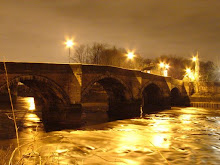
flood wall

The restorative work on the river defence wall along Broadgate has started and apparently the work will last a couple of months. It got me thinking as to what it would have been like before the wall was built so I went along to the Library to see if there are any flood records.

The earliest records I could find were from 1771, 1799, 1833 and 1840 when on the 17th August Preston experienced ‘a perfect hurricane’. In 1866 on the 16th November the most serious and wide spread damage for 200 years was experienced. ‘The Ribble and the Darwen are one’ and ‘the old portion of Avenham Park was filled up and rose much above the level of the lake in the park’ ( what lake would that be? ). In Broadgate there was a sea of water with houses jutting out of it. Occupants bundled furniture upstairs and sailed off to Fishergate Hill. People in the centre of South Meadow Lane were hemmed in on all sides to a depth of 3 to 4 feet. Some houses were flooded at the bottom of Grafton, Lauderdale and Beech Streets. Water overflowed the end of Ribble Place and ran in the end of Taylor Street. The Regatta Inn had 4 foot of water flowing past its door. Workmen had to abandon Strand Road and move to Fishergate Hill. At its peak at 10-30pm water was running down Elm Street. In Fishergate water had risen as high as the base of Stanley Terrace.

After the flood subsided it was said that Strand road looked like the bed of a river. The foundations of the Pleasure Boat Inn were exposed ‘to the very bottom’.

In 1880 flood water washed against the houses of Broadgate.

There were other floods through the years at regular intervals and I don’t intend to just give a list of dates. However, I did find an interesting snippet in The Preston Guardian of 1921. It was dated the 31st December and there was a photograph of the river bank in Broadgate during a flood and the picture shows a street lamp standard half submerged. The words describe ‘ a big fresh down the Ribble, the water travelling at a great rate. A sixth of the West Cliff Cricket Ground was under water.’

What I couldn’t find, however, was the background to the building of the original Broadgate wall. This was partly as I would like to leave that for another month but mostly because I found it difficult to drag myself away from the adverts in the papers of the time.

One of my favourites was for ‘correct and distinctive Dress Wear from Austin Reed.’

‘Dress ties – the latest dress tie is the Regent tie, it’s the latest word in simplicity and an explanatory diagram is supplied’

‘Discerning men appreciate that Austin Read Dress Wear is not only correct in style and detail but possesses a distinctive, quiet simplicity rather than any suggestion of the extreme.’
I rather like to think that this would also describe this columnist.

Saturday, 8 November 2008

Broadgate Stories

Sitting in the Reference Library and wading through old books is fine but it’s a bit remote from real life – not to mention the numb feeling that spreads after a few hours on hard seats. So it was a real pleasure to be able to relax at Geoff and Joyce Tyrer’s house where Geoff gave me some insights into Broadgate over the years.

It’s never been clear to me where the boats used to be moored around the Continental area but I think I’ve got it now. Apparently there used to be a jetty opposite the side gate entrance to the pub but that was moved down river a bit to a ramp opposite Ferry House. Geoff said that when he was a boy the owner, Mr Cooton, used to let him and his mates bale out the boats after it had rained and in return they would be allowed to take one of the boats out up river where they would turn and come back bouncing down over the rapids – while Mr Cooton would be waving wildly from the bank to tell them off. Interestingly you can still make out the landing place for the Ferry on the other side of the river. It’s right at the end of the wall where it dips down to the water.

All that area was subject to flooding and he remembers well the date and time of the worst. 11-30 at night on the 20th November 1977. He’d checked the tides and went out with his children to check as it wasn’t too bad at the time and as they were watching a bore of water just rolled up South End flooding the road. As a result the wall was built in 1979.

Much to my surprise Geoff said there used to be a detached house on the site of the BAC club grounds near the river and half way to the Continental. No sign of it now or Mr Eccle’s orchard which also used to be on the site before the club was there. You can still see the entrances just along South Meadow Lane where tracks used to go into scrub land marked of by a big hedge which zigzagged across to the river separating it from the orchard and also the market garden which used to have flower beds – scrupulously avoided by a young Mr Tyrer and his mates when hunting for the odd apple.

He also told me that before South End was built the land was used as a Strawberry Gardens. And that Meadow Court was Saul’s Nursery with next to it Billy Lee’s field where the shopkeeper from South Meadow Lane used to keep his horse. Indeed the nursery stretched across South Meadow Lane into Hassock Close and further up nearer to West Cliff. You get a real feeling for how almost rural this area used to be not very long ago.

In the middle of all this the Victoria Bowling Club must have been a majestic sight with its Pavilion and car park where Woods Green is now with the Rolls and Bentleys
arriving to play a game. Which makes the fact that Preston Cricket Club has kept its land and historic Pavilion all the more commendable.
I’ve come to the end of this month’s column and we’ve only got as far as the middle of South Meadow Lane so rather than squash more stories into a couple of sentences we’ll leave them for another time. Many thanks to Geoff and Joyce – and for a large malt I won’t tell about the biscuits.

poem

remembrances


at
eleven
there’s a pause –
Feeling one’s heartbreaks
one’s breaths
rise
&
fall
some
Elevens,
there’s…
a
pause.


John Francis Osborne orig. November 2001